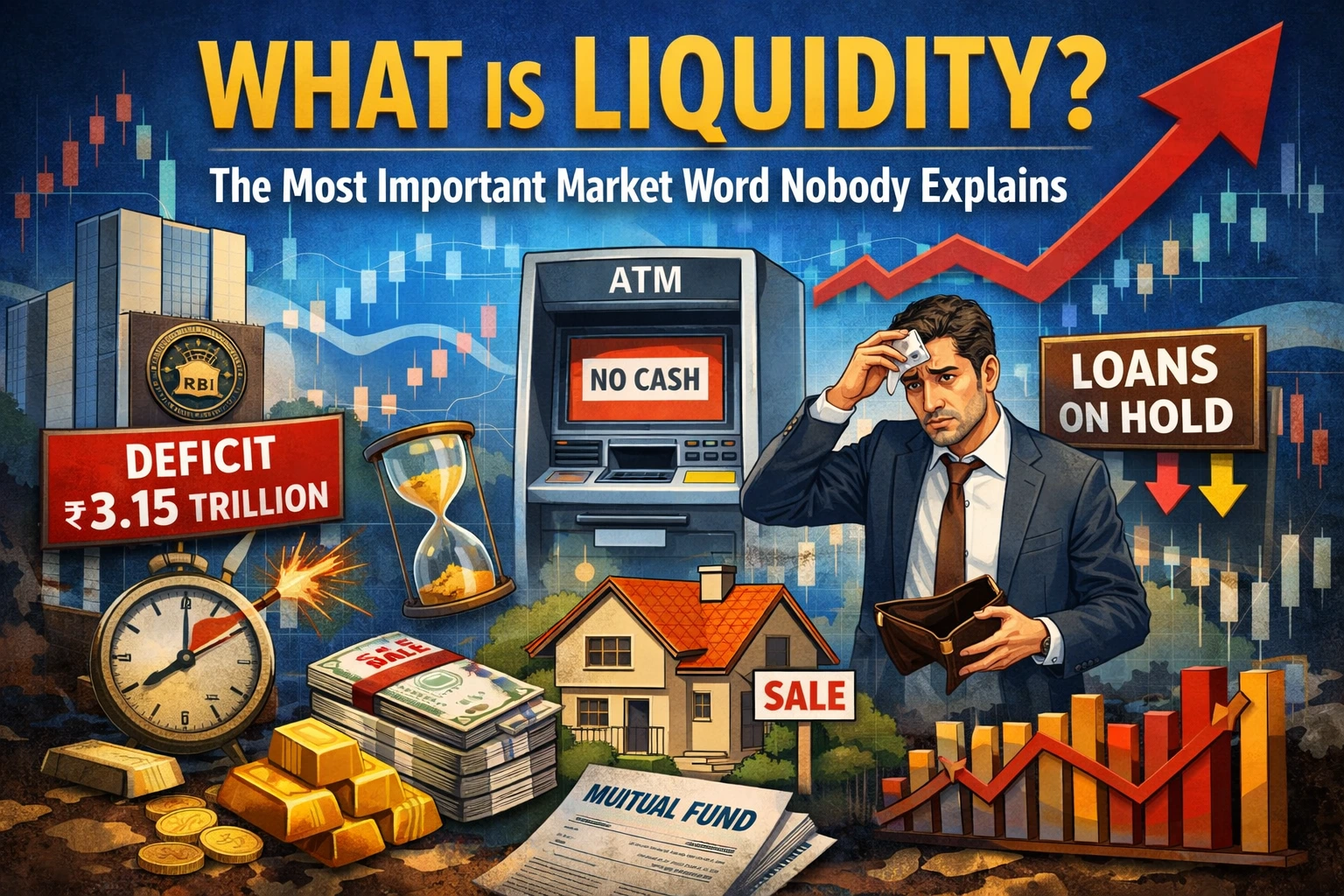
It is January 23, 2025. You wake up, check the news, and see this headline: “Banking system liquidity deficit hits ₹3.15 trillion worst in 15 years.” You scroll past it. What does that even mean? Liquidity deficit? Should you care?
Two weeks later, your home loan EMI suddenly does not get processed. The bank says there is a “temporary delay.” You try withdrawing ₹50,000 from your fixed deposit to cover it and to your surprise bank says it will take 3 business days instead of usual instant transfer. Now you are worried.
This is liquidity. Or rather, this is what happens when liquidity disappears. It is the single most important concept in finance and yet almost no one cares to explain it in plain language. Bankers talk about it in jargon. News anchors mention it without context. And you the investor, the borrower, the saver are left confused.
This article fixes that. We are going to explain liquidity from the ground up, using real-world examples from India’s recent liquidity crisis, the 2008 global meltdown, and everyday situations you actually face. By the end, you will understand what liquidity is, why it matters, how it dries up, and what it means for your money.
What Is Liquidity? The Simplest Definition
Liquidity is how easily you can convert something into cash without losing value. That is it. That is the core concept. Everything else builds from there.
Lets use Real-Life Examples
Your Savings Account: You have ₹1 lakh in your savings account. You need ₹50,000 right now. You go to an ATM, withdraw it. Done. Your savings account is HIGHLY liquid, you can convert it to cash instantly, at full value, with zero loss.
Your Car: You own a car worth ₹10 lakh. You need ₹5 lakh urgently. You try to sell it. No one will pay ₹10 lakh on the spot. You find a buyer willing to pay ₹7.5 lakh immediately. You take the loss. Your car is ILLIQUID converting it to cash takes time, effort, and you lose value in the process.
Your Mutual Fund: You have ₹5 lakh in a liquid mutual fund. You need ₹2 lakh. You place a redemption request. The money hits your account in 1–2 business days at net asset value (NAV). Your mutual fund is MODERATELY liquid fast, but not instant.
Liquidity is not about how much something is worth. It is about how fast you can turn it into cash without taking a loss. The faster and easier the conversion, the more liquid the asset.
The Liquidity Spectrum
| Asset | Time to Convert | Liquidity Level |
|---|---|---|
| Cash | Instant | 100% Liquid |
| Savings Account | Instant | Very High |
| Liquid Mutual Fund | 1–2 Days | Very High |
| Listed Stocks | 2 business days | very high |
| Fixed Deposit | 3–7 Days | High |
| Gold | 1–3 Days | Moderate |
| Unlisted Stocks | Weeks to Months | Low |
| Real Estate | Months to Years | Very Low |
| Art Collections | Months to Years | Very Low |
Why Liquidity Matters: What Happens When It Disappears
Liquidity is the lubricant that keeps the financial system running. When liquidity is abundant, everything works smoothly: banks lend easily, EMIs get processed instantly, businesses can borrow to expand, and stock prices move efficiently. But when liquidity dries up, the entire system seizes up like an engine without oil.
What a Liquidity Crunch Feels Like for You
Imagine you have ₹50,000 in your bank account. Your salary is delayed by 10 days. You have ₹30,000 in bills to pay. Normally, you would just use your credit card and pay it off when salary arrives. But your credit limit is maxed out from last month’s expenses. You check your fixed deposit ₹2 lakh locked for another 8 months. Breaking it early means losing 1–2% interest. You own gold worth ₹1.5 lakh, but selling it will take 3 days and the jeweler will offer you 5% below market price.
Also read: Understanding Financial Crisis
You have assets worth ₹4 lakh. But you cannot pay ₹30,000 in bills. That is illiquidity. You are asset-rich but cash-poor. This is exactly what happens to banks, companies, and even entire economies during a liquidity crisis except on a scale of billions of rupees.
CASE STUDY: India’s January 2025 Liquidity Crunch
On January 23, 2025, India’s banking system hit a liquidity deficit of ₹3.15 trillion ($37 billion) — the worst cash crunch in 15 years. What does that actually mean?
A liquidity deficit means banks collectively do not have enough cash on hand to meet their immediate obligations — loan disbursements, EMI processing, ATM withdrawals, interbank payments. To fill this gap, they have to borrow from the RBI overnight at the repo rate (6.50% at the time). When the deficit is ₹3.15 trillion, banks are borrowing that much just to keep the system running.
What Caused This?
Five major factors simultaneously drained liquidity from the system:
1. Forex Intervention – RBI Sold $80 Billion to Defend the Rupee
Between October 2024 and January 2025, the rupee fell sharply — from ₹83 to ₹86.70 per dollar. To stop further depreciation, RBI sold dollars and bought rupees from the market. When RBI sells dollars, it absorbs rupees from banks, reducing the cash available in the system. Selling $80 billion sucked out roughly ₹6.7 lakh crore from the banking system.
2. FPI Outflows – Foreign Money Left India
Foreign institutional investors (FPIs) pulled out ₹2.12 lakh crore from October 2024 to February 2025. When FPIs exit, they sell rupees and buy dollars, further reducing rupee liquidity in the system.
3. Advance Tax Payments
In December and January, companies pay quarterly advance taxes. Billions of rupees move from bank accounts to government coffers, temporarily reducing cash in the banking system. This is seasonal but significant.
4. Festive Currency Leakage – Cash Hoarded During Weddings
India’s wedding season (November–February) sees massive cash withdrawals. People hoard cash for ceremonies, gifts, and transactions. This cash does not return to banks immediately, creating a currency leakage — cash leaves the formal banking system.
5. Slow Deposit Growth
Bank deposit growth slowed to 9.9% YoY in December 2024, the slowest since March 2023. Why? Savers shifted money from bank FDs (offering 6.5–7%) to equity mutual funds and direct stocks (offering 10–15% returns). Banks had fewer deposits to lend, worsening the liquidity squeeze.
As liquidity tightened, overnight borrowing costs rose sharply above the policy repo rate.
THE RESULT: By mid-January 2025, the Weighted Average Call Rate (WACR) the overnight interest rate banks charge each other spiked to 6.69%, far above the repo rate of 6.50%. Banks were so desperate for cash that they paid 19 basis points MORE than the RBI’s rate just to borrow overnight
How RBI Injected Liquidity
When liquidity dries up, the Reserve Bank of India has several tools to pump cash back into the system. Here is what they did in 2024–25:
Tool 1: CRR Cut: Freeing Up Locked Cash
The Cash Reserve Ratio (CRR) is the percentage of deposits that banks must park with RBI, essentially frozen, earning zero interest. In December 2024, RBI cut CRR from 4.50% to 4.00%, releasing ₹1.16 lakh crore into the system immediately. Banks could now lend that money or use it for operations.
Tool 2: Open Market Operations (OMO): Buying Government Bonds
RBI announced it would buy ₹1 lakh crore worth of government bonds from banks in March 2025 (₹50,000 crore on March 12, another ₹50,000 crore on March 18). When RBI buys bonds, it pays banks in cash. Banks get liquidity; RBI gets bonds. This is called quantitative easing printing money to inject liquidity.
Tool 3: Variable Rate Repo (VRR) Operations: Short-Term Cash Injections
Between December 2024 and January 2025, RBI pumped ₹11.5 lakh crore into the system through VRR auctions short-term loans (1–7 days) to banks. This is emergency liquidity, temporary cash to keep the system functioning day-to-day.
Tool 4: Forex Swaps: Lending Dollars Against Rupees
RBI can lend dollars to banks in exchange for rupees, with an agreement to reverse the transaction later. This injects rupees into the system without permanently selling RBI’s dollar reserves. In early 2025, RBI injected ₹2.2 lakh crore via forex swaps.
TOTAL LIQUIDITY INJECTED IN FY25:
- ₹1.16 lakh crore (CRR cut)
- ₹1 lakh crore (OMOs)
- ₹11.5 lakh crore (VRR operations)
- ₹2.2 lakh crore (Forex swaps)
Total: ₹15.86 lakh crore. The largest single-year liquidity injection in Indian history.
CASE STUDY: The IL&FS Crisis
The 2018 IL&FS default triggered a chain reaction across NBFCs. Mutual funds faced redemptions, lenders stopped funding, and credit markets froze. This was not just a solvency issue, it was a liquidity crisis. Even healthy companies struggled because nobody wanted to lend temporarily.
In September 2018, Infrastructure Leasing & Financial Services (IL&FS) a ₹91,000 crore infrastructure financing giant defaulted on a bond payment. That single default triggered a chain reaction that nearly collapsed India’s NBFC sector.
The Liquidity Freeze
Here is where liquidity disappeared:
- Mutual funds that held IL&FS debt faced redemption requests from panicked investors. They had to sell other assets to raise cash.
- Banks and NBFCs that had lent to IL&FS (and similar companies) stopped lending to ALL NBFCs even healthy ones. Why? Fear. If IL&FS could default, anyone could.
- NBFCs that relied on short-term borrowing to fund long-term loans suddenly could not roll over their debt. Their funding dried up overnight.
- Housing finance companies, vehicle finance NBFCs, and small business lenders faced a funding freeze. They could not lend. Credit markets seized.
This is a liquidity crisis at the systemic level. It was not that NBFCs were insolvent (worthless). It was that no one would lend to them, even temporarily. Liquidity evaporated.
Liquidity in Everyday Financial Decisions
Real Estate Trap
You bought a flat for ₹80 lakh five years ago. Today, it is worth ₹1.2 crore. You need ₹20 lakh urgently for your child’s education. You try to sell the flat. No buyers. You lower the price to ₹1.1 crore. Still no buyers. You try a loan against property (LAP) the bank offers ₹60 lakh at 10% interest after 30 days of processing. You are stuck. You own ₹1.2 crore in assets but cannot access ₹20 lakh. This is illiquidity.
Breaking a Fixed Deposit
You have ₹10 lakh in a 5-year FD at 7.5% interest. You are in year 3. You need ₹5 lakh urgently. Breaking the FD early means: (a) you lose 1% interest (penalty), (b) it takes 3–5 days for the bank to process, (c) you lose compounding benefits. Your FD is moderately liquid, but you pay a price for liquidity.
Small-Cap Stock Crash
You own ₹5 lakh worth of shares in a small-cap stock. The company announces poor earnings. The stock falls 20% in one day. You want to sell, but there are no buyers. The order book shows bids only at 30% discount. If you sell at market price, you get ₹3 lakh instead of ₹5 lakh. The stock is listed, but it is illiquid low trading volume means you cannot exit without massive losses.
Why Liquidity Should Shape Your Investment Strategy
Most investors focus on returns: “This stock gave 50% last year!” or “This real estate project promises 20% appreciation!” But liquidity is often more important than returns. Here is why:
1. Liquidity = Optionality
Liquid assets give you flexibility during emergencies or opportunities. Liquid assets give you options. If an emergency hits medical crisis, job loss, business opportunity you can access your money instantly. Illiquid assets lock you in. You might have ₹50 lakh in real estate, but if you cannot sell it in 30 days, it is useless in an emergency.
2. Illiquidity Is Expensive
Banks charge higher rates on loans backed by illiquid collateral. Banks charge 2–4% higher interest on loans against property vs loans against liquid mutual funds. Why? Because they know real estate is hard to sell if you default. Illiquid collateral = higher risk = higher interest. Every illiquid asset costs you more to monetise.
3. Emergency Funds Must Be Liquid
Keep emergency money in savings accounts or liquid funds never locked assets. Your emergency fund (6 months of expenses) should NEVER be in real estate, unlisted stocks, or long-lock-in FDs. It must be in savings accounts, liquid funds, or short-term FDs. Liquidity is the entire point of an emergency fund.
4. Diversify by Liquidity
Most people diversify by asset class: stocks, bonds, real estate, gold. But you should also diversify by liquidity. Have a mix of highly liquid assets (mutual funds, stocks), moderately liquid (FDs, gold), and illiquid (real estate, unlisted equity). Do not put everything in illiquid buckets.
| Liquidity Tier | Assets | % of | Purpose |
|---|---|---|---|
| Instant | Savings, Liquid Funds | 10-15% | Emergency fund, daily expenses |
| 1–7 Days | Equity MF, Stocks, FDs | 50-60% | Growth |
| 1–6 Months | Gold, Debt Funds | 20-25% | Stability |
| 1+ Years | Real Estate, Unlisted Equity | 5-10% | Long-Term Wealth |
The Bottom Line: Liquidity Is Financial Oxygen
Liquidity does not promise flashy returns but without liquidity, nothing else works. Your investments become locked, opportunities disappear, and even strong portfolios struggle during crises.
The best investment in the world is worthless if you cannot access it when you need it most.
Plan. Invest. Prosper. | prosperpocket.in