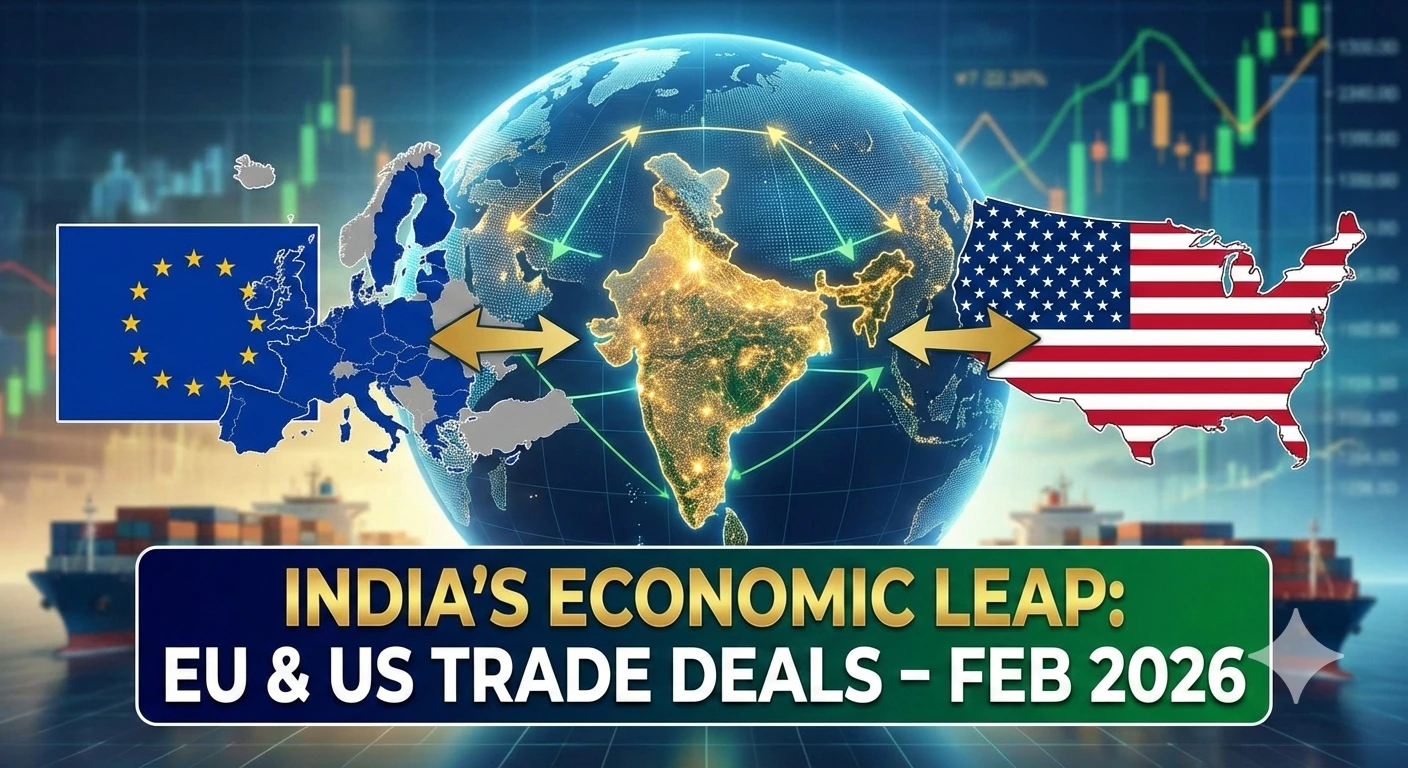
In the first two weeks of February 2026, India rewrote its economic future — twice. On January 27, India concluded the India–EU Free Trade Agreement, the largest trade deal either party has ever signed. Just ten days later, on February 6, India and the United States announced their landmark Interim Trade Agreement.
Together, these two deals connect India to markets accounting for roughly 42% of global GDP. For investors, businesses, and anyone with a stake in India’s economy, understanding what these deals really mean beyond the headlines is essential.
Here are the 10 most important takeaways from both deals combined.
THE BIG PICTURE
01. India Has Secured Access to 42% of Global GDP in 10 Days
The combined economic heft of the US ($28T) and EU ($19T) represents roughly 42% of world GDP. India has now locked in preferential relationships with both blocs simultaneously a strategic milestone for long-term growth ambitions under Viksit Bharat 2047.
This is the single most important macro context for India’s economic ambitions. Viksit Bharat 2047 requires India to grow from a $3.9 trillion to a $30+ trillion economy. Deep trade integration with the world’s two largest economic blocs is not optional it is the architecture on which that growth must be built.
02. India Is Now More Competitive in Export Markets Than China
US tariffs on Indian goods are now around 18%, compared with roughly 30–35% on Chinese goods. India has a meaningful cost advantage in the world’s largest consumer market. On the EU side, Indian exporters in textiles, gems, pharmaceuticals, and engineering goods now enter the EU with preferential or zero tariffs, while Chinese goods face standard MFN rates.
This is the China+1 thesis made real by policy. For companies building supply chains outside China, India is no longer just an option it is now the structurally advantaged option in both of the world’s most important destination markets.
Preferential EU access further strengthens India’s supply-chain positioning under the China+1 strategy.
03. Not Just Trade Deals: A Geopolitical Repositioning
India’s alignment with US technology frameworks and EU regulatory systems signals a structural shift toward deeper integration with Western economic blocs, shaping long-term capital and technology flows.
India’s decision to pivot away from Russian crude oil (as part of the US deal) and align with EU regulatory and investment frameworks is a generational geopolitical statement. India is no longer playing a pure non-aligned balancing act — it is choosing deep economic integration with the democratic, rules-based economic order.
That is a strategic bet on where capital, technology, and long-term prosperity flow. The US deal deepens the iCET (Initiative on Critical and Emerging Technology) framework and opens India’s nuclear energy sector to US companies. The EU deal adds a Security and Defence Partnership alongside the FTA. Both deals together move India firmly into the Western economic orbit while PM Modi’s government frames it as strengthening “stability in the international system”.
WHAT INDIA WINS
04. Labour-Intensive Exporters Are Immediate Winners
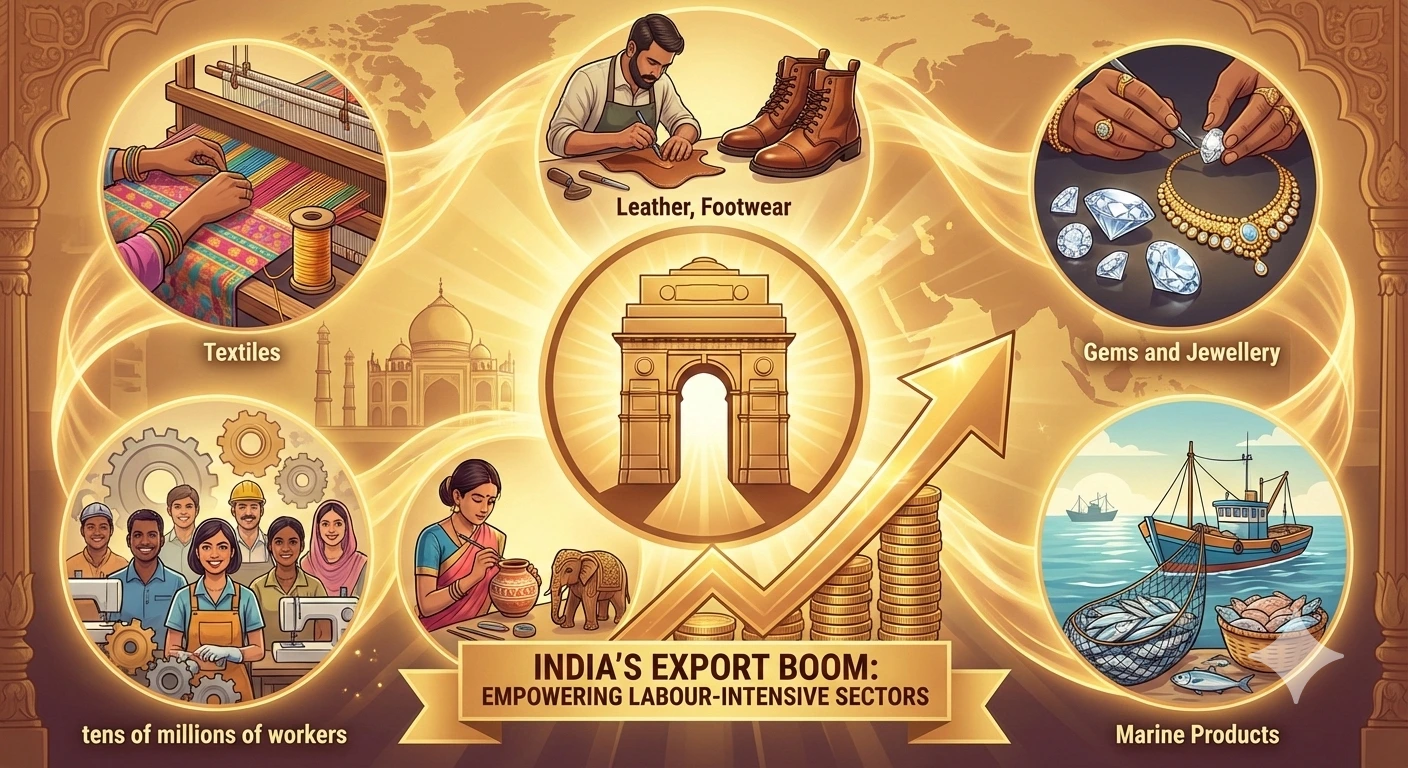
The single most immediate economic benefit of both deals flows to India’s labour-intensive export sectors — textiles, leather, footwear, gems and jewellery, marine products, and handicrafts. These industries employ tens of millions of workers, mostly in small and medium enterprises.
| Sector | US Deal Benefit | EU Deal Benefit |
|---|---|---|
| Textiles & Apparel | 18% tariff competitiveness | Preferential EU access |
| Gems & Diamonds | Zero tariff | EU market expansion |
| Leather & Footwear | Restored export edge | Full preferential access |
| Marine Products | Better margins | Expanded EU exports |
| Pharma | Zero tariff generics | Near-zero EU tariffs |
05 — Services Industry Hits a New Gear
India’s $265 billion technology services sector exports primarily through services, not goods — so tariff cuts matter less than market access frameworks. The EU deal delivers something far more valuable: access to 144 EU services sub-sectors and a structured Mobility Framework for Indian professionals across all 27 EU member states.
- Access to 144 EU services sub-sectors
- Mobility framework for Indian professionals
- Formal EU recognition for AYUSH practitioners
- US iCET tech cooperation strengthens IT exports
06. FDI and Private Capex Could Accelerate
Trade certainty removes a major investment barrier. EU investment protection frameworks and US policy stability may unlock the next wave of manufacturing and infrastructure capex.
One of the most underappreciated consequences of trade uncertainty is its chilling effect on investment decisions. Businesses don’t build factories or commit supply chains when policy could reverse overnight. Both deals remove that uncertainty — and the investment response should follow.
Goldman Sachs had estimated a 0.3 percentage point drag on India’s GDP growth from US trade policy uncertainty alone. That headwind is now lifted. The EU deal adds an Investment Protection Agreement and dispute resolution framework that gives European capital the legal certainty it needs to commit to India at scale. Cumulative EU FDI into India was $117 billion through 2024 — this deal should meaningfully accelerate that trajectory.
THE REAL TRADE-OFFS
07. Agriculture Is the Most Politically Sensitive Variable
Tariff discussions around sorghum, soybean oil, and specialty foods remain contentious. Dairy and cereals remain protected, but future negotiations could test domestic political stability.
Both deals require India to open its agricultural markets to foreign competition — and this is the deal’s most politically sensitive pressure point. The US expects India to reduce tariffs on dried distillers grains, sorghum, nuts, soybean oil, and wine. The EU has pushed for access for wines, spirits, and specialty foods.
India has drawn firm red lines around dairy, cereals, and poultry — sectors where 44% of the population earns its livelihood. Sensitive sectors have largely been excluded from both deals for now. But the full BTA negotiations with the US (targeted for late 2026–2027) will push harder. Any major concession here risks farmer protests reminiscent of 2020–21. Investors should monitor this space carefully as the full BTA takes shape.
08. Energy Costs May Rise Short Term
India’s pivot away from discounted Russian crude oil — a condition of the US deal — is the most immediate financial cost. Russian oil was arriving at steep discounts, acting as a buffer against global energy price inflation. Shifting procurement to US LNG, Venezuelan crude, and Middle Eastern suppliers likely means higher average import costs.
-
- Key Risks to Watch:
-
-
- • Current account deficit projected to widen to $37 billion in 2026 (Goldman Sachs)
-
- • Higher energy import bills could push inflation toward the RBI’s 4% target faster
-
- • The Chabahar port Iran waiver expires April 26, 2026 — a live geopolitical risk
-
- • Steel/aluminium exporters face EU’s Carbon Border Adjustment Mechanism (CBAM)
-
- Also read:
09. Auto and Alcohol Sectors Face Competition
EU car tariffs gradually falling from 110% to ~30–35% introduce competitive pressure in India’s premium vehicle segment. Domestic spirits brands also face stronger EU competition.
The EU FTA’s biggest domestic disruption is in automobiles. India has agreed to cut tariffs on EU cars from 110% to 30–35%, phasing toward 10% over time, with a 250,000-vehicle annual quota. Indian auto stocks Tata Motors, Maruti, Mahindra, and Hyundai India fell 1.3–4.2% on deal announcement day.
The government’s safeguards (price floor: below €15,000 excluded; phased timeline; quota cap) limit the immediate damage. But the medium-term competitive pressure on India’s premium and upper-mid car segment is real. Similarly, domestic alcohol brands face stiffer competition from EU wines and spirits under both deals, with United Breweries and Sula Vineyards dropping 2–4% on deal day.
THE INVESTOR LENS
10. The Structural Bull Case for India
Both deals together reinforce what is already a compelling India growth story and add a structural layer of durability to it. Here is where the macro numbers currently stand:
.
| Metric | 2026 Outlook |
|---|---|
| Real GDP Growth | ~6.4%–7.4% |
| Services Export Growth | ~11% YoY |
| FII Flows | Expected to recover after $22bn sell-off in 2025 |
| Private Capex | Lagged recovery expected H2 2026 (Goldman Sachs) |
| Bank Credit Growth | Improving; ₹6.3 lakh crore liquidity injected |
| Inflation (Headline) | Rising to ~3.9%, near RBI’s 4% target |
| Current Account Deficit | Widening to ~$37 billion in 2026 |
| Rupee Outlook | Stabilising from 90/$ lows; range-bound near term |
THE PROSPERPOCKET INVESTOR VERDICT
Both deals are structural long-term positives for India. The market will not re-rate overnight ratification takes time, implementation takes more time, and agriculture/auto headwinds are real. But the direction is unambiguous.
Sectors to accumulate on dips: Textiles, Pharma, IT Services (EU-facing), Gems & Jewellery, Auto Ancillaries (component makers who supply EU OEMs), Marine & Food Processing.
Sectors to watch with caution: Auto OEMs (premium segment), Domestic Alcohol, Steel exporters with EU exposure.
Accumulate on Dips
- Textiles
- Pharma
- EU-facing IT services
- Gems & Jewellery
- Auto Ancillaries
- Marine & Food Processing
Quick Reference: Both Deals at a Glance
| India–US Interim Deal | India–EU FTA | |
|---|---|---|
| Date | Feb 6, 2026 | Jan 27, 2026 |
| US Tariff on India | 50% → 18% | N/A |
| India’s Concessions | Tariff cuts + $500bn purchases | Auto tariffs + Agri access |
| Key Sector Winners | Textiles, Pharma, Gems, IT | Textiles, Pharma, Gems, Services |
| Key Sector Risks | Agriculture, Energy costs | Autos, Alcohol, CBAM/Steel |
| Geopolitical Signal | Pivot from Russian oil | EU Security & Defence Pact |
| Full Deal Target | BTA: Late 2026 / 2027 | Legal scrub: 5–6 months |
| Status | In force | Pending ratification |
The Bottom Line
In just ten days, India has deepened economic ties with both the world’s largest economy and its largest trading bloc. The negotiations were painful, the concessions are real, the implementation road is long but the strategic direction is unmistakable.
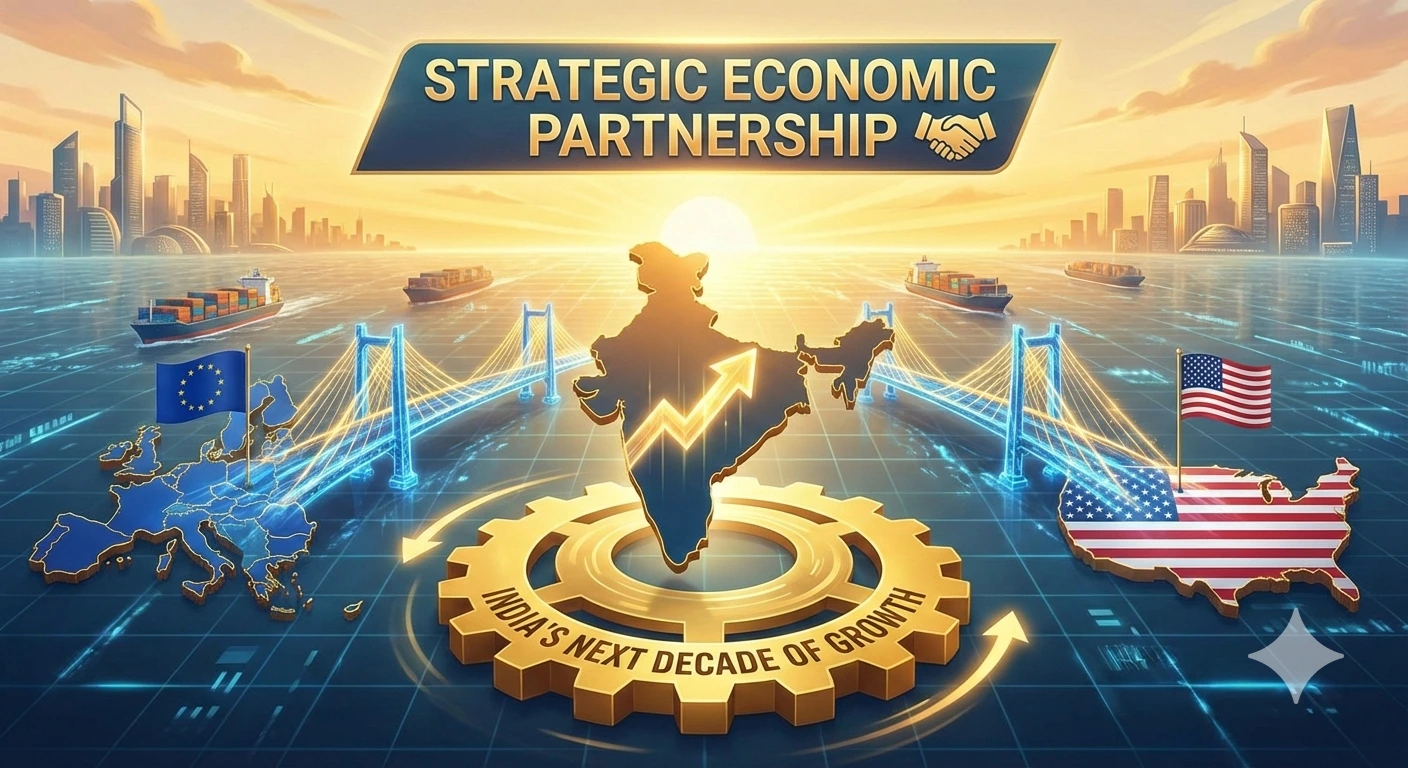
India’s economy is growing faster than any other major economy. Its demographics, domestic demand, and manufacturing ambitions are unmatched. And now, for the first time, the world’s two most important destination markets have given Indian goods and services preferential access to compete and win.
For long-term investors, this is not just a trade story. It is the foundation of India’s next decade of growth.
Additional read: Vajirao Institute & Outlook India
© 2026 ProsperPocket | Plan. Invest. Prosper. | prosperpocket.in