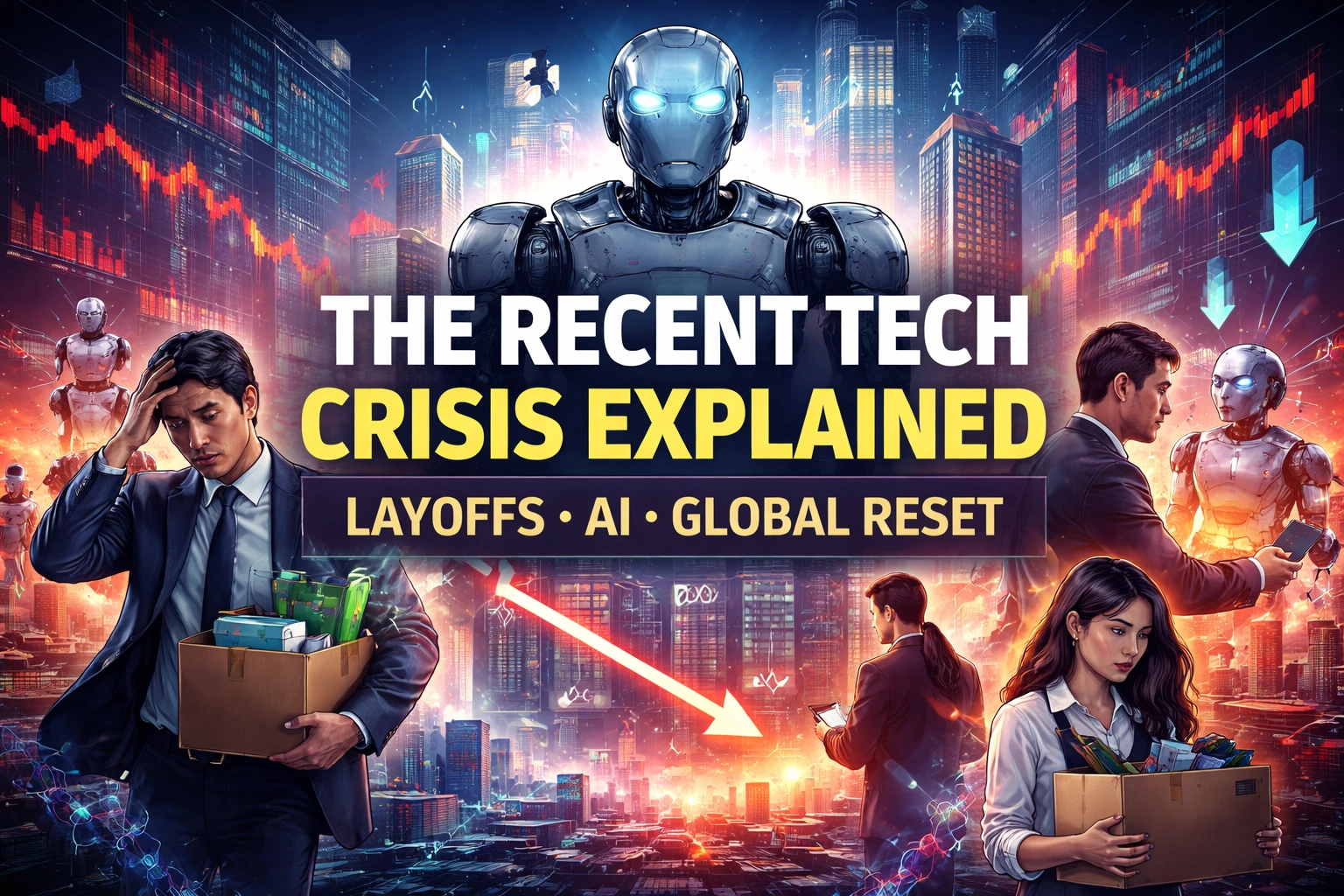
The global technology industry is currently passing through one of its most complex transition periods since the early 2000s, marked by widespread layoffs, artificial intelligence disruption, funding slowdowns, and valuation corrections across both public markets and startup ecosystems. While headlines often describe this moment as a collapse of the tech sector, deeper economic analysis suggests the industry is undergoing a structural reset following aggressive expansion during pandemic years.
Ultra-low interest rates between 2020 and 2022 encouraged companies to hire rapidly and invest heavily in growth initiatives, creating cost structures that became difficult to sustain once global monetary policy tightened. As inflation rose and central banks increased rates, investors began demanding profitability and operational efficiency instead of pure growth metrics. This transition created visible turbulence across markets while innovation spending continued rising beneath the surface. Understanding the recent tech crisis therefore requires separating short-term market reactions from long-term technological transformation.
The Layoff Wave: Correction After Pandemic Expansion
The most visible symbol of the recent tech crisis has been the wave of layoffs announced by major global companies across multiple technology sectors including cloud computing, social media, gaming, and enterprise software. Industry trackers estimate that hundreds of thousands of employees were affected globally between 2022 and 2025, making it one of the largest restructuring phases in modern technology history. However, employment data reveals that many companies had expanded their workforce aggressively during pandemic years when remote work drove unprecedented demand for digital platforms. As growth normalized and advertising revenue slowed, organizations faced increasing pressure from investors to align costs with sustainable revenue projections.
Layoffs therefore became a strategic recalibration rather than a signal that technology demand had disappeared. Analysts emphasize that hiring continues in specialized areas such as cybersecurity, artificial intelligence engineering, and cloud architecture, suggesting that the workforce reset reflects changing skill priorities rather than industry contraction.
Key Data Points Behind the Layoff Trend
Several measurable indicators highlight how employment dynamics changed during this period, including slower hiring growth rates, declining stock-based compensation structures, and increased focus on profitability metrics across corporate earnings reports. Financial disclosures from major technology firms show a renewed emphasis on operating margins and cost discipline once capital became more expensive due to rising interest rates. Startup ecosystems also reported hiring freezes and extended recruitment cycles as venture capital funding slowed compared to pandemic peaks, reinforcing the broader trend toward cautious expansion.
Historical comparisons indicate that similar workforce corrections occurred after earlier technology booms, including the post-dot-com period, suggesting that layoffs often follow phases of excessive hiring. Data from global job platforms further reveals that demand for specialized technology roles remained stable even as layoffs dominated headlines, highlighting the nuanced nature of the current crisis. The contrast between layoffs and ongoing hiring demonstrates that the industry is not shrinking uniformly but shifting toward more technically specialized talent.
Artificial Intelligence: Innovation Driving Both Growth and Anxiety
AI Investment Is Reshaping the Tech Industry
Artificial intelligence has emerged as one of the most powerful forces driving change within the technology sector, influencing how companies allocate resources, design products, and structure their teams. Major firms are investing billions into AI infrastructure, machine learning platforms, and advanced computing capabilities, often redirecting funding away from legacy business units or experimental divisions. This transformation has created uncertainty because AI adoption frequently alters productivity expectations and reduces the need for certain repetitive tasks, raising concerns about job displacement.
Venture capital data shows a significant shift toward AI-focused startups and enterprise automation solutions, reflecting investor belief that the next growth phase will be driven by intelligent systems rather than purely consumer-focused applications. Economists studying technological revolutions note that rapid innovation cycles historically create periods of workforce instability before productivity gains become widely visible. The rise of AI therefore represents both an opportunity for long-term growth and a source of short-term disruption for professionals navigating the evolving technology landscape.
Funding Trends Showing the AI Shift
Investment patterns across global markets reveal increasing capital allocation toward sectors such as generative AI, semiconductor design, robotics, and advanced cloud infrastructure. Startups with clear enterprise use cases and scalable AI models have attracted significant funding, while consumer applications without strong monetization strategies face growing investor skepticism. This shift has changed hiring priorities, with companies increasingly seeking engineers capable of building complex machine learning systems rather than expanding non-technical teams.
Data center construction and demand for high-performance computing resources have also increased, indicating that AI infrastructure is becoming a foundational pillar of the modern digital economy. Analysts believe that this transition mirrors earlier technological revolutions in which foundational innovations reshaped entire industries over time. Understanding these investment trends helps explain why layoffs and growth can occur simultaneously within the same sector as resources move toward new technological frontiers.
Interest Rates, Valuations, and the Financial Reset
How Monetary Policy Triggered Market Corrections
The global shift toward higher interest rates has played a crucial role in reshaping the technology sector, particularly because tech companies often rely on future growth expectations rather than immediate profitability. When borrowing costs rise, investors discount future earnings more aggressively, leading to lower valuations for companies that previously benefited from abundant liquidity.
Market data shows that major technology indices experienced sharp corrections as central banks tightened monetary policy to combat inflation across developed and emerging economies. This environment forced companies to prioritize cash flow and operational efficiency instead of aggressive expansion, fundamentally changing corporate strategy across the industry. Analysts frequently point out that valuation resets are a normal part of financial cycles, especially in sectors driven by innovation and long-term projections. Rather than signaling weakness, the financial reset has encouraged more disciplined investment practices that could strengthen the technology ecosystem over time.
Data Signals Pointing Toward Profitability Focus
Corporate earnings reports reveal increasing emphasis on efficiency metrics such as operating margins, free cash flow, and sustainable revenue growth, reflecting changing investor expectations. Venture capital funding volumes declined compared to pandemic highs, yet deal quality improved as investors became more selective about business fundamentals and long-term scalability. Companies with diversified revenue streams and strong balance sheets performed better during market volatility, highlighting the importance of financial resilience in uncertain environments. Market analysts observe that firms capable of demonstrating profitability regained investor confidence more quickly than those dependent on continuous external funding.
This trend represents a broader maturation of the technology industry, where growth narratives alone are no longer sufficient to justify high valuations. The shift toward disciplined financial strategies suggests that the current crisis may ultimately create a more stable and sustainable innovation ecosystem.
India’s Tech Ecosystem: Resilience Within Global Turbulence
India’s technology ecosystem has demonstrated resilience during the global tech reset, supported by strong domestic digital adoption, expanding fintech platforms, and a rapidly growing startup culture. While venture capital funding moderated compared to pandemic peaks, sectors such as SaaS, enterprise software, and digital payments continued expanding due to India’s large internet user base and improving infrastructure. Layoffs within Indian companies were often tied to global restructuring decisions rather than local market weakness, highlighting the interconnected nature of modern technology ecosystems.
Analysts emphasize India’s demographic advantage and engineering talent pool as key factors attracting long-term investment despite short-term volatility. Government initiatives supporting semiconductor manufacturing and artificial intelligence development further strengthen India’s position within the evolving global tech landscape. These structural advantages suggest that India remains a critical player in the next phase of technological innovation despite global market uncertainty.
Regulation and Governance: The New Pressure on Big Tech
Increasing regulatory scrutiny has added another layer of complexity to the recent tech crisis, with governments around the world introducing new frameworks addressing data privacy, competition, and artificial intelligence governance. Technology companies must now invest heavily in compliance systems and risk management strategies, influencing product development timelines and operational costs. While some industry leaders argue that stricter regulation could slow innovation, others believe it creates a more predictable environment that strengthens user trust and investor confidence.
Global policy trends are reshaping how companies approach expansion strategies, particularly in regions where regulatory stability plays a significant role in attracting capital. Analysts observe that governance expectations are evolving alongside technological progress, forcing firms to balance innovation with accountability. Understanding this regulatory dimension provides a more complete picture of the tech crisis beyond purely financial or employment-related narratives.
Conclusion: Crisis or the Beginning of a Mature Tech Era?
The recent turbulence in the technology sector reflects a convergence of macroeconomic tightening, artificial intelligence disruption, changing investment priorities, and evolving regulatory expectations rather than a single catastrophic event. Historical patterns suggest that technology industries often move through cycles of rapid expansion followed by consolidation phases that strengthen long-term stability.
Layoffs and valuation corrections, while disruptive, may ultimately lead to a healthier ecosystem focused on sustainable innovation and realistic financial strategies. Data-driven analysis shows that research spending and AI development continue to grow despite short-term volatility, indicating that technological progress remains strong. For readers and investors, the key lesson is to distinguish between structural transformation and temporary market sentiment. The current tech crisis may therefore represent not the end of growth but the beginning of a more disciplined and resilient phase in global technological evolution.
ProsperPocket Editorial Perspective
At ProsperPocket, our goal is to analyse markets through long-term data and structural trends rather than short-term narratives. The recent tech crisis reflects a broader transition toward artificial intelligence, disciplined capital allocation, and evolving regulatory expectations shaping the future of global digital economies.