PROSPERPOCKET.IN | REALITY CHECK
The numbers are brutal and they tell a very different story from YouTube trading gurus.
The Brutal Truth: SEBI’s Data Exposed
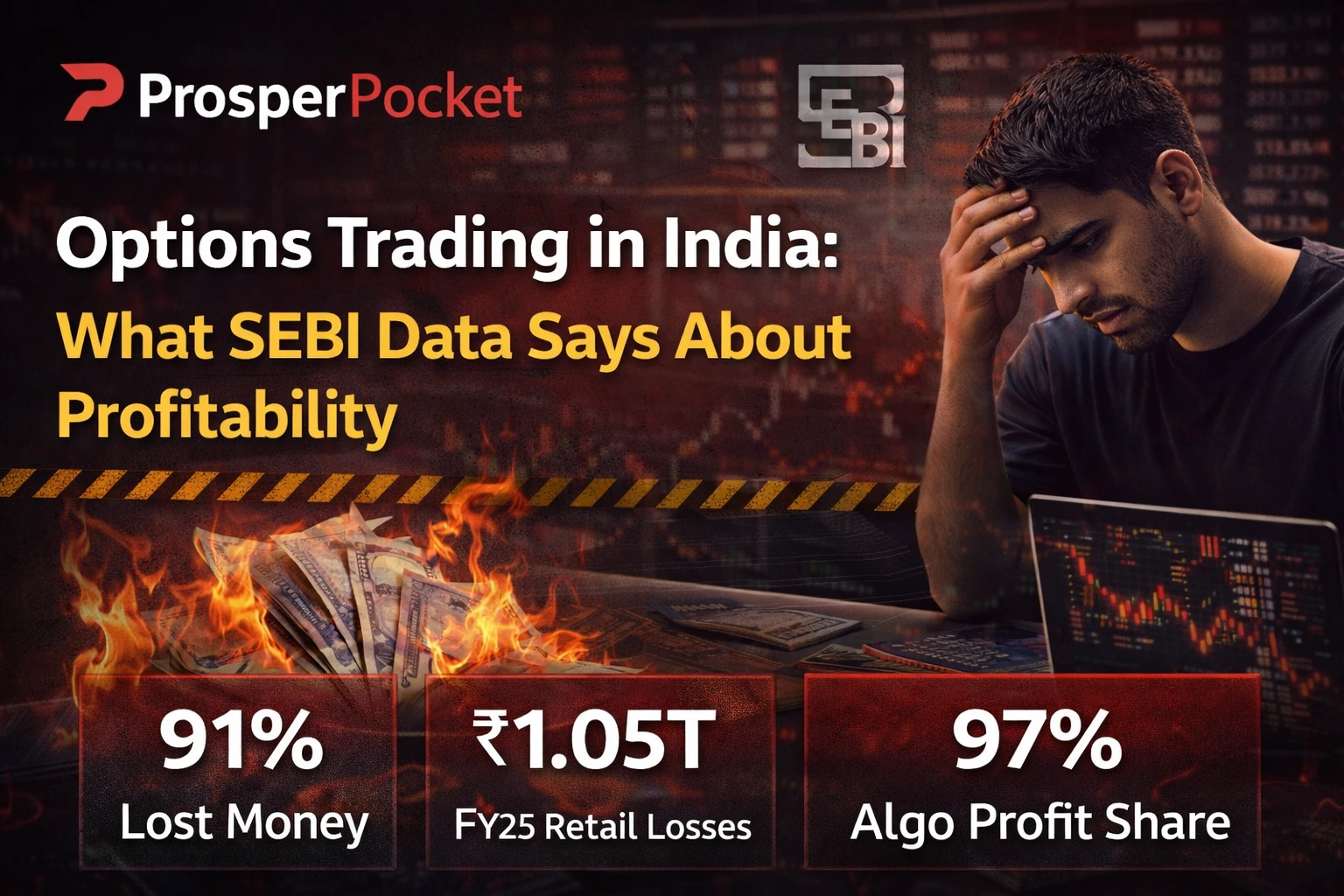
Option Trading where 91% of retail traders lost money in FY25. Total retail losses crossed ₹1.05 trillion. Only 1% made more than ₹1 lakh profit over three years. Meanwhile, institutional algo traders captured the majority of gains.
If you have watched YouTube lately, you have seen them. The finfluencers. Sitting in rented BMW showrooms, standing in front of MacBooks with 47 trading charts open, promising you that options trading is the fastest way to financial freedom. “I made ₹2 lakh in one day,” they say. “You can too. Just follow my Telegram group.”
And millions of Indians young, optimistic, desperate to escape the grind of a 9-to-5 believed them. In FY25 alone, 26.5 lakh unique retail traders entered the equity derivatives market. Most of them had never traded before. Most of them earned less than ₹5 lakh a year. And 91% of them lost money.
This is not speculation. This is not opinion. This is hard data from SEBI India’s Securities and Exchange Board the regulator tasked with protecting investors. And the data is devastating.
This article breaks down the entire story: what options trading really is, who is making money (spoiler: not you), why retail traders are getting destroyed, what SEBI has tried to do about it, and most importantly whether you should ever trade options at all.
What Is Options Trading? (And Why It Destroys Beginners)
An option gives you the right but not the obligation to buy or sell an asset at a fixed price before expiry. Calls bet on price rising. Puts bet on price falling. The leverage involved makes profits look easy but losses happen just as fast.
Call Option
You buy a call option when you think the price will go UP. You are betting that Nifty (or a stock) will rise above a certain level before expiry.
Example: Nifty is at 25,000. You buy a 25,200 call option expiring Tuesday. If Nifty crosses 25,200, you profit. If it does not, your premium (the money you paid for the option) is gone.
Put Option
You buy a put option when you think the price will go DOWN. You are betting Nifty will fall below a certain level.
Example: Nifty is at 25,000. You buy a 24,800 put option. If Nifty falls below 24,800, you profit. If it stays above, you lose your premium.
The Leverage Trap
With ₹10,000, traders can control positions worth several lakhs. Small price movements can double capital or wipe it out completely. This structure attracts beginners but heavily favours institutional players. This is not investing. This is not even trading. It is gambling with a 30-second timer. And the house the institutional traders, the algo firms, the hedge funds knows the odds. You do not.
The Data: Retail Carnage in Numbers
FY24 (2023–24): The First Wake-Up Call
| Metric-FY24 | Value |
|---|---|
| Total individual F&O Traders | 7.3 Million |
| Traders Losing Money | 91.1% |
| Average Loss per losing trader | ₹1.20 Lakh |
| Traders who made profit | 8.9% (650,000) |
| Average profit per winning trader | ₹1.03 lakh |
| Total retail losses | ₹61,000 crore |
| Transaction costs paid by retail | ₹26,000 per trader (27% of losses) |
FY22–FY24 (Three-Year View): It Gets Worse
| Metric (3 Years) | Value |
| Total unique traders over 3 years | 9.6 million |
| Traders who lost money | 93% (8.9 million) |
| Average loss per losing trader | ₹2 lakh (₹66,667/year) |
| Total retail losses (cumulative) | ₹1.81 lakh crore ($21.5 billion) |
| Top 3.5% of losers (400,000 traders) | Lost ₹28 lakh each on average |
| Traders who made >₹1L profit (post-costs) | 1% (96,000 people) |
| Transaction costs (3 years) | ₹50,000 crore (₹50,000 per trader) |
Over a three-year period, 93% of traders lost money with average losses nearing ₹2 lakh per person. Transaction costs alone consumed massive portions of trader capital.
FY25 (2024–25): Despite New Rules, Losses Exploded
SEBI thought its October 2024 regulations would help. They did not. The losses widened.
| Metric (FY25) | Value |
| Total unique traders | 26.5 lakh (2.65 million) |
| Traders who lost money | 84% (22 lakh+) |
| Total retail losses | ₹1.02 lakh crore to ₹1.05 lakh crore |
| Increase in losses vs FY24 | +41% (from ₹61,000 Cr to ₹1.05L Cr) |
| Average loss per trader | ₹1.1 lakh |
| Average profit per winner | ₹2.1 lakh |
| Index options (% of trading volume) | 95% of all retail F&O volume |
THE BOTTOM LINE: 91% of retail F&O traders lose money. This is not bad luck. This is not a market correction. This is structural. The game is rigged against you. And it has been for years.
Who Is Making Money?
For every rupee lost by a retail trader, someone else made that rupee. Here is where the money went in FY24:
| Player Type | Gross Profit (FY24) | % Algo Trading |
|---|---|---|
| Proprietary Traders | ₹33,000 Crore | 96% |
| FPIs | ₹28,000 Crore | 97% |
| Retail Traders | −₹61,000 Crore | ~5% |
Algorithmic traders execute in microseconds, while retail traders operate manually creating a structural disadvantage that cannot be closed through education alone.
The Algo Advantage: Microseconds vs Minutes
97% of FPI profits and 96% of proprietary trader profits came from algorithmic trading. These are machines executing trades in microseconds, analysing millions of data points, reacting to price movements faster than your screen can refresh.
You the retail trader are using your phone. You are watching a YouTube video on technical analysis. You are placing orders manually. By the time you click “Buy,” the algo traders have already moved the price, taken their profit, and moved on to the next trade.
This is not a fair fight. You are bringing a knife to a drone strike.
The Jane Street Case: When SEBI Catches Them Red-Handed
In July 2025, SEBI barred Jane Street a global algorithmic trading firm from India’s equity derivatives market, accusing it of manipulation. The incident shone a spotlight on how professional firms exploit retail traders legally and efficiently.
Jane Street’s strategies are legal in most jurisdictions. They are fast. They are sophisticated. And they work. The problem? When 91% of retail traders are losing to these systems, the market stops being a market. It becomes a slaughterhouse.
Why Do 91% of Retail Traders Lose? The Structural Reasons
This is not about skill. Most retail traders are not stupid. They are outmatched. Here is why:
Reason 1: You Are Playing Against Machines
Algo traders execute in nanoseconds. They have direct market access. They co-locate servers next to exchange servers to shave milliseconds off order execution. You are using your phone on a 4G connection.
Reason 2: Transaction Costs Kill You
Every trade you make costs money: brokerage (₹20–100 per lot), exchange fees, STT (Securities Transaction Tax), GST, and SEBI turnover charges. These add up to 22–27% of your gross profits (if you have any). For losing traders, transaction costs add another 27% to losses. You need to be right 55–60% of the time just to break even.
Reason 3: Weekly Expiry = Gambling Addiction
Until SEBI’s 2024 reforms, there were weekly expiries on Bank Nifty, Nifty, Fin Nifty, and Midcap Nifty every single day of the week. This created a “daily lottery” mindset. Traders would lose Monday, try to recover Tuesday, lose again Wednesday, and chase losses all week. SEBI now allows only ONE weekly expiry per exchange (Nifty on NSE, Sensex on BSE). But the damage is done — the addiction is real.
Reason 4: You Are Chasing Momentum, Not Value
Retail traders do not trade fundamentals. They trade trends they see on Telegram groups and YouTube. “Nifty broke 24,200 resistance!” “RSI crossed 70!” These are not strategies. They are reactions to price movements created by algo traders front-running your orders.
Reason 5: You Cannot Afford to Lose But You Keep Playing
75% of F&O traders earn less than ₹5 lakh a year. That is ₹42,000 a month. And they are risking ₹50,000–₹1 lakh in leveraged trades. One bad trade wipes out months of savings. But instead of stopping, they double down, trying to recover losses. This is how gambling addiction works.
SEBI’s Attempt to Save You From Yourself
Starting October 2024, SEBI rolled out a series of aggressive reforms to curb retail destruction. Here is what they did:
Reform 1: Increased Minimum Contract Size (Nov 2024)
- Old minimum: ₹5–10 lakh notional value
- New minimum: ₹15–20 lakh notional value
- Impact: Lot size for Nifty increased; Sensex lot size from 10 to 20. This priced out small traders with ₹10,000–20,000 capital.
Reform 2: Only One Weekly Expiry Per Exchange (Nov 2024)
- NSE: Only Nifty has weekly expiry now. Bank Nifty, Fin Nifty, Midcap Nifty discontinued.
- BSE: Only Sensex has weekly expiry. Sensex 50 and Bankex discontinued.
- Impact: Reduced daily gambling opportunities. Forced traders to think beyond “today’s expiry.”
Reform 3: Upfront Premium Collection (Feb 2025)
- Brokers must collect full option premium upfront from buyers before placing trades.
- Impact: Prevents leveraged speculation beyond your actual capital. No more “margin trading” on options premium.
Reform 4: No Calendar Spread Benefit on Expiry Day (Feb 2025)
- Previously, traders holding offsetting positions across expiries got margin relief. Not anymore.
- Impact: Forces early rollovers, reduces expiry-day speculation and volatility.
Reform 5: Additional 2% Extreme Loss Margin on Expiry Day (Nov 2024)
- Short option sellers must put up an extra 2% ELM on expiry day to cover tail risk.
- Impact: Makes selling options more capital-intensive, especially on volatile expiry days.
Reform 6: Intraday Position Monitoring (April 2025)
- Exchanges must capture position snapshots 4 times daily (not just end-of-day).
- Impact: Prevents traders from exceeding position limits intraday and covering it up before closing.
Reform 7: Higher STT on Futures & Options (Budget 2026)
- Government sharply increased Securities Transaction Tax on derivatives — from 0.1% to 0.15% on options, from 0.125% to 0.15% on options exercised, and from 0.02% to 0.05% on futures.
- Impact: Raises trading costs for high-frequency and speculative traders, making excessive intraday or short-term F&O trading less profitable while leaving long-term investors mostly unaffected.
DID IT WORK?
Partially. Unique retail traders fell 20% YoY in Dec 2024–May 2025. Index options turnover fell 9% in premium terms and 29% in notional terms. But losses in FY25 still hit ₹1.05 lakh crore — up 41% from FY24. Why? Because the traders who stayed were the most desperate. They traded MORE, not less, trying to recover losses.
The Finfluencer SCAM: FEEDING THE MACHINE
Studies suggest only 2% of influencers are SEBI-registered advisors, yet many promote options trading aggressively. Premium Telegram groups, screenshot marketing, and course selling have created a pipeline that feeds new traders into high-risk markets.
According to a CFA Institute study (March 2025), only 2% of financial influencers in India are SEBI-registered investment advisors. Yet 33% give explicit stock recommendations. And almost all of them push options trading as the “fastest path to wealth.”
Here is how the scam works:
- Step 1: Finfluencer posts a screenshot of ₹2 lakh profit in one day (fake or cherry-picked)
- Step 2: “Join my Telegram premium group for ₹5,000/month — I’ll give you live calls”
- Step 3: 10,000 people join. Influencer makes ₹5 crore/month. Subscribers lose everything.
- Step 4: Influencer blames “market conditions” and launches a new course for ₹10,000.
SEBI has started cracking down. But with thousands of finfluencers on YouTube, Instagram, and Telegram, enforcement is nearly impossible. The damage is already done.
Should You Ever Trade Options? The Honest Answer
For most retail investors, the honest answer is no. Unless options are used for hedging or by professionals with advanced infrastructure, the odds remain heavily stacked against individuals.
IF YOU EARN LESS THAN ₹10 LAKH A YEAR: You cannot afford the losses. 75% of F&O traders earn under ₹5 lakh. One bad trade can wipe out 3–6 months of savings. This is not wealth creation. This is financial suicide.
IF YOU ARE USING A PHONE OR LAPTOP: You are already outmatched. Algo traders execute in nanoseconds. You are using retail platforms with 100–500ms latency. By the time you see the price, it is already gone.
IF YOU LEARNED FROM YOUTUBE: You are following strategies designed to generate content, not profits. Real traders do not share their edge on YouTube. They are too busy making money.
IF YOU THINK YOU CAN “LEARN AND GET BETTER”: 93% of traders lose money consistently over 3 years. This is not a learning curve. This is a market designed to extract money from retail and give it to institutions. You are not improving. You are funding their bonuses.
The ONLY Scenarios Where Options Make Sense
- You are hedging an existing portfolio (e.g., you own ₹50 lakh in stocks and buy put options as insurance)
- You are an institution with algo infrastructure, co-location, and a team of quants
- You have spent 5+ years learning, lost money learning, and now trade with strict stop-losses and position sizing
If none of those apply to you and they almost certainly do not, stay out. Buy index funds. Build wealth slowly. Do not gamble it away on weekly expiries.
Conclusion: The Casino You Cannot Win
Options trading in India has evolved into a system where institutions and algorithms dominate. Retail traders supply liquidity — often at significant personal cost. The smartest trade for most investors may be the one they never place.
Options trading in India has become a national crisis. 26.5 lakh traders most of them young, most earning under ₹5 lakh a year lost ₹1.05 lakh crore in FY25 alone. That is ₹1,05,000 crore. That is more than the GDP of 40+ countries. That is wealth destruction at scale. SEBI knows this. They have tried to stop it. They increased contract sizes. They removed weekly expiries. They forced upfront premium collection. They also increased STT. And still, the losses keep growing.
Additional read: SEBI Report & AI Stock Bubble
Why? Because the system is not broken. It is working exactly as designed. Retail traders are the product. Algo traders are the customers. And finfluencers are the salespeople. If you are reading this and thinking “But I can be in the 9%” you are wrong. The 9% who win are either institutions, algo traders, or people who got lucky once and will lose it all next year. The data does not lie. 93% lose over 3 years. That is you.
The best trade you will ever make is the one you do not make. Stay out of F&O. Invest in index funds. Build wealth slowly, steadily, and safely. Let the machines fight each other. You do not belong in this game.
ProsperPocket Insight: Markets reward patience, discipline, and risk management not speed. If a strategy promises fast wealth, it is usually designed to sell you something, not make you rich.