
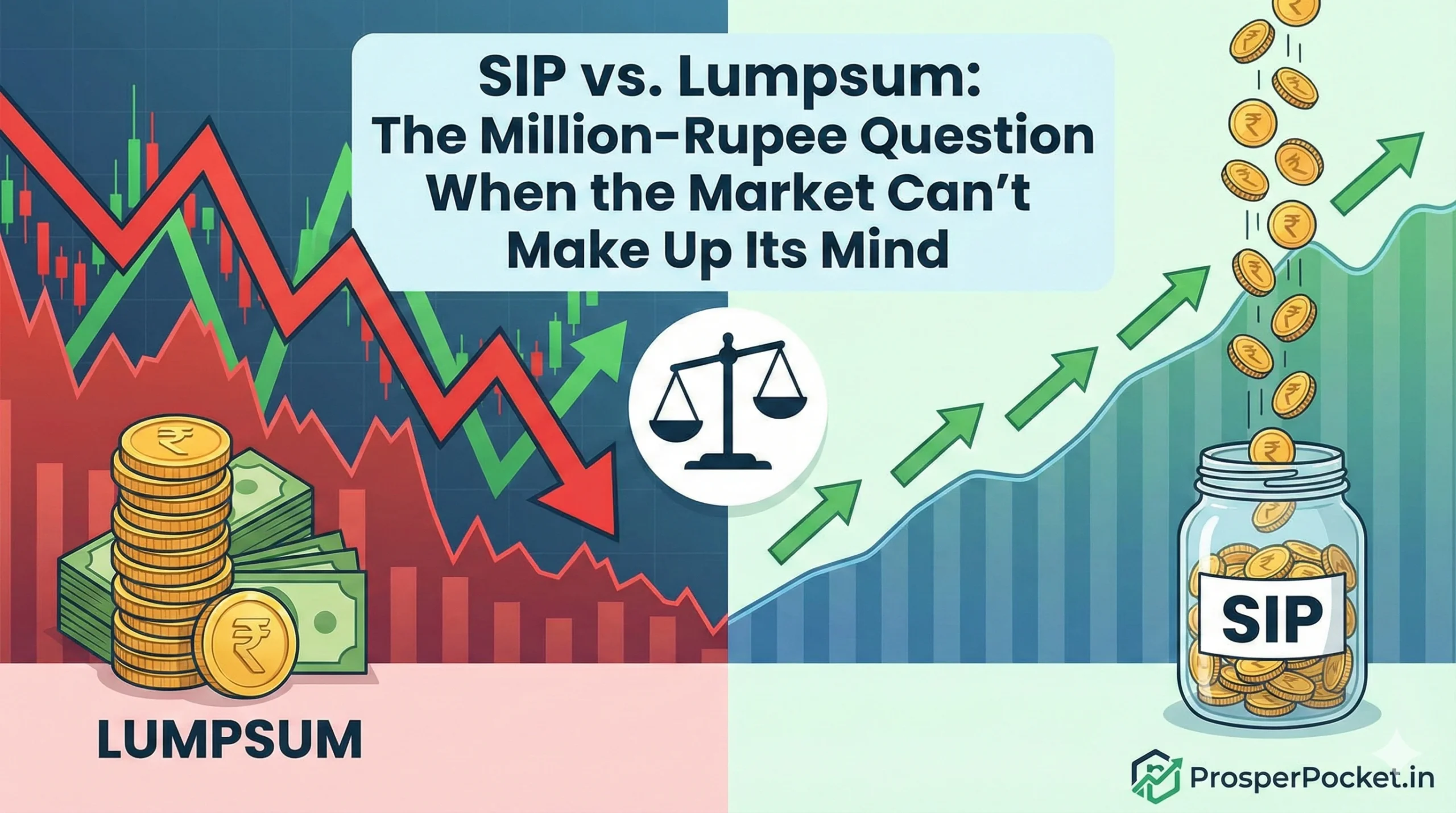
SIP vs Lumpsum vs STP: Best Investment Strategy for a Volatile Market (2025 Guide)
Let’s be real for a second. We have all been there.
You open your Groww or Zerodha app and see green everywhere. The Sensex is soaring, your mutual funds are shining — and your inner Warren Buffett whispers, “Invest that extra ₹2 lakhs now!” But one day later the market crashes. What now?
This is the classic investor’s paralysis.
If you’re sitting on a pile of cash — a yearly bonus, sale proceeds, or just accumulated savings — you’re facing the toughest question in personal finance: Do I jump in all at once (Lumpsum), or tiptoe in slowly (SIP)? Or use the hybrid STP?
The “Lumpsum” Temptation (And Why It’s Dangerous)
The logic behind lumpsum is simple: markets rise over long periods, so the sooner you invest, the longer compounding works for you. Historically, over very long horizons, lumpsum beats SIPs roughly 60% of the time.
But there’s a catch — sequence of returns risk. If a major crash comes right after you invest, your portfolio can suffer severe short-term losses that take years to recover. Many investors panic-sell after such drops, locking in losses.
The “Bad Timing” Nightmare
Picture January 2008. Someone invests ₹10 Lakhs in a Nifty 50 fund. Two months later the Global Financial Crisis wipes out almost half the value. Mathematically you might recover in 7–8 years; psychologically you may never return.
The Magic of SIPs (The Vegetable Market Strategy)
SIP = Systematic Investment Plan. For many, SIPs are a salary-based habit. For someone with a lumpsum, SIPs act as a risk management tool.
The Onion Analogy
- Month 1: Onions cost ₹80/kg — you buy less.
- Month 2: Price crashes to ₹20/kg — you buy more with the same budget.
Rupee cost averaging means buying more units when prices are low and fewer when they’re high. If the market stays volatile, SIPs benefit from those dips and smooth your average entry price.
The Data Showdown (A Tale of Two Investors)
We compare two hypothetical investors who both had ₹12 Lakhs on January 1, 2010, covering a choppy market (2010–2013).
Arjun — The Lumpsum Risk-Taker
- Invested ₹12 Lakhs into a Sensex Index Fund on Day 1.
- Market choppy — dipped in 2011, rose in 2012, dipped again.
- Result by 2013: Portfolio barely moved; ~4% CAGR.
Meera — The SIP Strategist
- Kept money in bank; started SIP of ₹33,000/month for 3 years (≈₹12L).
- Bought more units during down cycles, fewer on highs.
- Result by 2013: XIRR ~10–12% — significantly ahead of Arjun.
| Scenario | Arjun (Lumpsum) | Meera (SIP) |
|---|---|---|
| Investment Style | ₹12L all at once | ₹33K/month for 3 years |
| Return (2010–2013) | ~4% CAGR | ~10–12% XIRR |
| Risk Level | High — timing risk | Lower — averaged entries |
Verdict: In sideways, choppy, or volatile markets, SIP often outperforms by reducing timing risk and preserving investor psychology.
The Third Option – The “Smart” Compromise (STP)
STP (Systematic Transfer Plan) is our recommended strategy for most readers who have a sizable lump sum but want protection from timing risk.
How STP Works (Step-by-step)
- Parking Spot: Invest your lumpsum (e.g., ₹10L) in a Liquid or Ultra-Short Duration Debt Fund where it earns ~6–7% (better than savings).
- Transfer: Instruct the AMC to transfer a fixed amount (e.g., ₹1L/month) from the debt fund to an equity fund.
- Outcome: Idle money earns returns while equity exposure builds gradually via Rupee Cost Averaging.
Why STP is ideal for volatility:
- If the market goes up: parts are already invested and you benefit immediately.
- If the market goes down: remaining transfers buy cheaper units.
- Eliminates the regret factor (you neither fear missing out nor fear getting crushed by a sudden drop).
The Decision Checklist
Consider LUMPSUM if:
- The market has already crashed 15–20% from its peak (valuations look attractive).
- Your time horizon is very long (15+ years).
- You have a very high risk tolerance and won’t panic at large drawdowns.
Consider STP if:
- The market is at or near all-time highs, or showing wild swings.
- The investment amount is large relative to your net worth (e.g., 50%+).
- You value smoother returns and lower emotional stress.
Practical Steps — What to Do Now
- Don’t leave your lump sum in a savings account.
- Open your investment app and look for a reputable Liquid/Ultra Short Duration Fund (HDFC, ICICI, SBI are common fund houses — check current yields).
- Park the money there and immediately set up a monthly STP into a Nifty 50 or Flexi-Cap equity fund for 6–12 months.
- If you prefer full safety and lower returns, extended STP (12 months) smooths the ride further.
Final Thoughts: It’s Not About Math — It’s About Sleep
Numbers matter, but so does psychology. A lumpsum may win on paper if the market proceeds upward immediately after you invest. But spreadsheets don’t experience panic. STP gives you a middle path: your idle cash earns a modest return while your equity exposure builds with averaging.
In the current global and domestic climate — where geopolitical events, inflation data, and RBI policy moves can cause sharp swings — conservative, psychology-aware strategies like STP are often the right choice for most retail investors.
Actionable Next Step
- Don’t let your lumpsum sit idle — move it to a Liquid Fund.
- Set a monthly STP into a chosen equity fund (Nifty 50 or Flexi-Cap).
- If you want, start with a 6-month STP and extend to 12 months depending on market comfort.
Happy Investing!
(Disclaimer: This article is for educational purposes only. ProsperPocket does not provide personalized financial advice. Consult a SEBI-registered Investment Advisor before making significant financial decisions.)
Further reading:
AMFI India (official mutual fund information)
About the Author: The ProsperPocket Team simplifies finance for everyday investors. We publish practical guides on mutual funds, RBI policy impacts, and long-term wealth building.


Pingback: Understanding Financial Crises: Why They Repeat & How to Spot the Next One - ProsperPocket