

Indian office desks with AI chatbot interface on a monitor, symbolizing AI impact on jobs
AI is no longer a futuristic idea
Artificial intelligence (AI) is no longer a futuristic idea — it is already changing how Indians work. Call centers are experimenting with chatbots, banks are testing AI for faster loan approvals, and hospitals are using AI scans for early detection. For India, where over 65% of the population is below 35, the question is urgent: how will AI disrupt jobs, and how can millions of young workers prepare? Studies from the World Economic Forum, McKinsey, and Goldman Sachs suggest that while millions of jobs will be transformed or displaced, new opportunities will also arise.
How big is the change?
The World Economic Forum estimates that around 23–25% of existing jobs globally will change significantly within five years due to AI and automation. In India, the scale could be even bigger because of the country’s reliance on service jobs like IT, BPO, and financial back-office work. McKinsey’s earlier models suggested that worldwide, 400–800 million people might need to switch jobs by 2030 under rapid automation scenarios. For India, this could translate into tens of millions of workers needing reskilling over the next decade.
On the positive side, AI is also projected to boost global GDP by up to 7%, with India well-positioned to benefit because of its large talent pool and growing tech ecosystem.
India sector-by-sector impact
1. IT and BPO (Business Process Outsourcing)
India’s IT and BPO industries employ over 5 million people directly and support millions more indirectly. These sectors thrive on tasks such as customer support, data processing, and coding maintenance — many of which AI can automate.
- Customer support: Generative AI-powered chatbots can now handle routine calls and email responses. A call center that needed 200 agents may now need only 120, with AI handling repetitive queries.
- Data entry & document processing: RPA (Robotic Process Automation) plus AI tools can read, classify, and process documents faster than humans.
Upside for India: Companies that move from low-end outsourcing to AI-enhanced outsourcing — offering analytics, data governance, and AI auditing — can retain global contracts. Workers who learn how to supervise AI systems and handle complex escalations will be in demand.
2. Banking, Finance & Insurance
AI is already being tested in Indian banks for fraud detection, KYC (Know Your Customer) checks, and loan approval automation. Clerical roles are most at risk, but demand for AI auditors, compliance experts, and risk managers will rise.
For example, an AI can scan hundreds of loan applications in minutes, flagging risk patterns. But final approval, relationship management, and regulatory accountability still require human bankers.
3. Manufacturing
India’s manufacturing is less automated than China’s, but that is changing. Sectors like automotive and electronics are adopting robotics with AI vision systems. Routine assembly jobs will shrink, but robotics technicians, process engineers, and AI-integrated quality controllers will grow in importance.
4. Healthcare
India faces a shortage of doctors (just over 1 per 1,000 people). AI-assisted diagnostics (like X-ray analysis or eye disease detection) can help bridge this gap. Rather than replacing doctors, AI helps them reach more patients faster. New opportunities will open for clinical data specialists, AI-lab technicians, and telemedicine operators.
5. Education
AI-driven personalized learning tools are entering Indian classrooms. Teachers who embrace these tools will be able to manage large classrooms better. However, rote-based tutoring businesses may shrink as AI apps provide low-cost alternatives. The opportunity lies in teachers becoming learning guides, mentors, and human connectors, roles AI cannot perform.
Who is most vulnerable in India?
AI will not hit all groups equally. Those most exposed include:
- Routine BPO workers — especially in Tier-2 cities where call centers provide major employment.
- Clerical banking staff — jobs like cheque clearing, form verification, and data reconciliation.
- Older workers with limited digital skills — harder to reskill into AI-driven roles.
- Rural youth entering the job market with only basic education and no digital training.
Without reskilling, these groups risk being left behind as AI adoption accelerates.
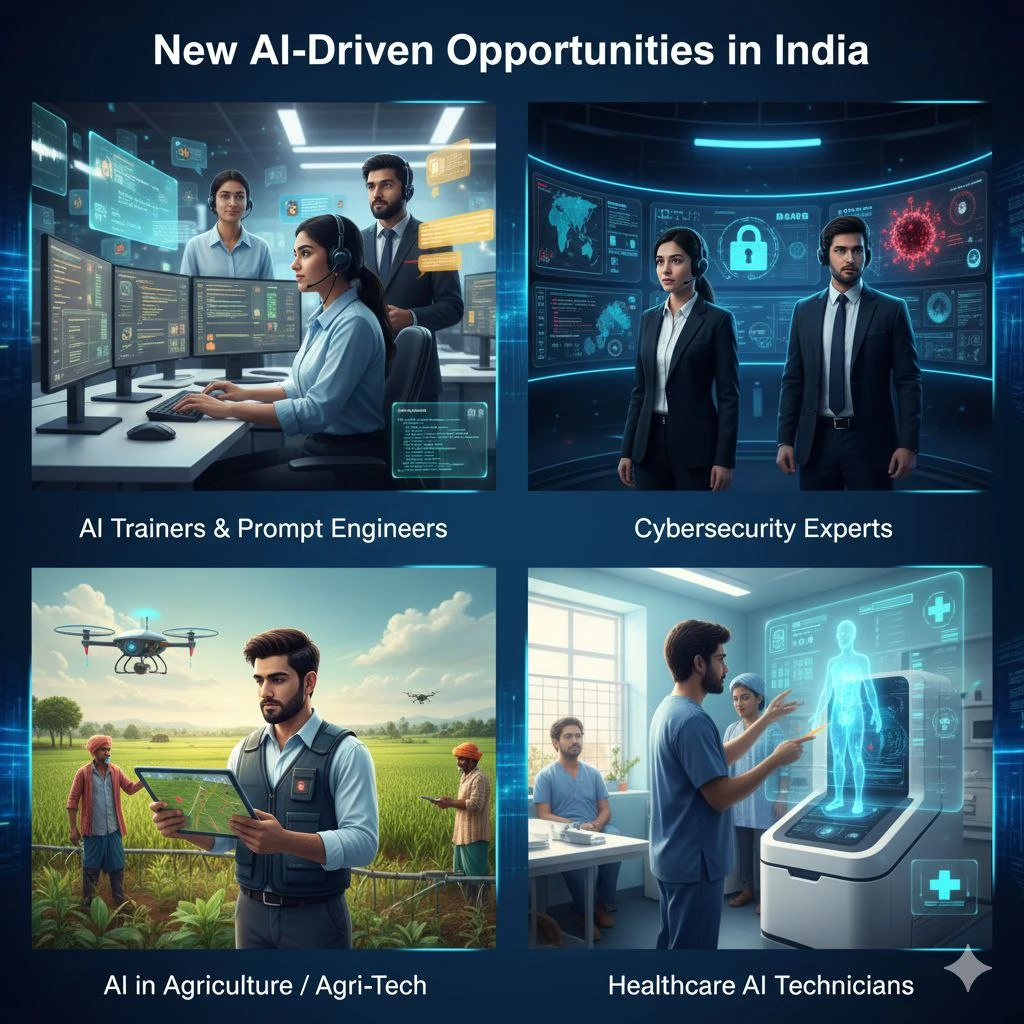
Where new opportunities will grow in India
Even as some jobs shrink, others will grow:
Practical steps for Indian workers
1) Reskill aggressively: Take short online certifications in data analytics, AI workflows, or domain-specific AI tools.
2) Shift from task-doer to problem-solver: Don’t just learn tools; learn how to apply them to business challenges.
3) Leverage India’s strengths: English fluency, mathematical skills, and IT services experience can be repositioned toward higher-value AI-enabled work.
4) Emphasize human skills: Communication, negotiation, and leadership remain irreplaceable.
Policy responses needed in India
To soften disruption and capture the upside, India will need:
- National reskilling missions: Large-scale government-backed training in AI, coding, and data for workers in Tier-2 and Tier-3 cities.
- Industry-academia partnerships: Engineering colleges integrating AI and data analytics into core curricula.
- Social safety nets: Schemes like PMKVY (Pradhan Mantri Kaushal Vikas Yojana) can be expanded to cushion displaced workers while they train.
- Incentives for AI-enhanced outsourcing: Encourage Indian firms to move from low-end BPO to AI-augmented global service hubs.
Conclusion: India’s challenge and opportunity
AI will reshape jobs worldwide, but for India it is both a risk and a once-in-a-generation opportunity. If workers and companies adapt quickly, India can move up the global value chain and use AI as a growth engine. If adaptation is slow, millions of routine jobs risk erosion.
The future will not be about humans versus AI, but humans with AI. India’s young workforce can excel if it learns to blend human judgment, creativity, and empathy with AI-driven productivity.



Hoki108slottm has a few slots I hadn’t seen before, so that was a bonus. Not a bad spot for spinning if you’re bored. Have a look: hoki108slottm